
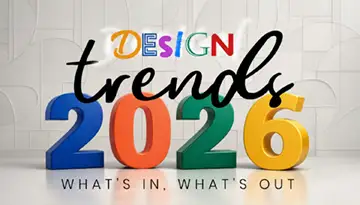
Design trends 2026 are all about one big shift: AI made “good design” easy, so real human taste became premium. In 2026 you’ll see more intentional imperfection, stronger typography, tactile textures, calm nature-led aesthetics, modular bento layouts, and smarter UI patterns like personalization, accessibility-first design, and “just enough” 3D depth.
In this guide, I’ll break down the top design trends 2026 in graphic design, branding, and UI/UX, with simple examples and practical tips so you can use them without looking “trendy” or template-like.
Last week I opened five different brand decks from five different businesses.
And guess what?
Same gradients.
Similar kind of “perfect” mockups.
Same clean sans font.
And same AI-ish shine.
Everything looked good and perfect, but nothing felt real.
That’s why 2026 is not about “more polished.” It’s about more human.
In 2026, these are the big moves:
- Imperfect / handmade details are back (grain, scribbles, collage, craft).
- Texture becomes brand identity, not decoration.
- Typography becomes the hero (expressive, emotional, joyful, even “grainy type”).
- Kinetic typography + motion gets more common (web + social + branding).
- Bento grids keep growing because they’re clean, scannable, and modular.
- Generative UI + personalization becomes a real product trend, not a buzzword.
- Accessibility + neuro-inclusion becomes “default good design.”
- Sustainable / low-carbon design moves from “nice idea” to “smart business.”
Why 2026 feels different (the shift nobody can ignore)
Two things are happening together:
1) AI is raising the baseline
In 2026, it’s easy to make “nice-looking” work quickly. Tools help. Templates help. AI helps. Canva even shared that a large chunk of creators now treat AI as a core partner in their workflow.
So “nice-looking” is no longer rare.
2) People are craving proof of humanity
That’s the counter-wave: texture, warmth, emotion, imperfection, personality.
Creative Bloq calls this shift a move away from slick, algorithm-friendly visuals toward more tactile, human-centric design.
In simple words:
Design is becoming less “perfect.” And more “felt.”
The Top design trends 2026 (and how to use them)
Trend 1: “Imperfect by design” (human is the new premium)
When every brand can generate polished visuals in minutes, the smooth, flawless look stops feeling premium. It starts feeling generic. That’s why “imperfect by design” is booming — tiny human details like grain, rough edges, uneven strokes, cut-and-paste collage, and real-world textures. Canva even frames 2026 around this idea: design that looks made, not manufactured.
The funny part? These imperfections don’t reduce quality. They increase trust. They make people pause and think, “Someone actually crafted this.”
So you are going to see more:
- hand-drawn lines
- rough edges
- imperfect shapes
- collage vibes
- real paper textures
- “anti-AI crafting” energy
Why it works: It feels believable. And trust is a design outcome.
Best for: personal brands, D2C, creator brands, community-first businesses, lifestyle brands.
How to use it without looking messy:
- Keep layout clean.
- Add one imperfect layer.
- Let the imperfection be the accent, not the whole design.
Trend 2: Texture becomes the identity (not just background)
In 2026, texture is not a “Photoshop layer.”
It becomes the brand’s voice.
Think:
- grain gradients
- ink / print texture
- fabric and emboss feel
- tactile illustration texture
Why it works: Texture triggers emotion fast. And it makes the design feel “owned,” not copied.
Quick rule:
If your design still works in black & white, then texture will enhance it. If it doesn’t, texture will only hide problems.
Trend 3: Typography is the main character
This is a big one.
In 2026, typography isn’t just “choose a font and move on.” Type is the design. Because layouts, colors, and AI visuals are getting easier to copy, brands are using typography to look unmistakably themselves—through bold headlines, custom letterforms, variable fonts, and clean-but-emotional spacing. When your type system is strong, even a plain layout looks premium.
In 2026 typography is moving away from the “same clean sans everywhere” look. Designers are leaning into expressive type that carries emotion and storytelling.
What you’ll see:
- bold, character-rich fonts
- warm serifs making a comeback
- “deliberate friction” (grainy or imperfect type)
- variable fonts used smartly for responsive design
How to use it (easy way):
- One strong headline font
- One simple body font
- Strong spacing
- Clear hierarchy
Best for: brand identities, social creatives, landing pages, ads, packaging, pitch decks.
Most iconic real-world examples to study (and why they matter):
- Apple — San Francisco: a full ecosystem type system built for UI clarity and consistency.
- Netflix — Netflix Sans: custom type to unify everything from billboards to tiny subtitles.
- Airbnb — Airbnb Cereal: created to make the brand feel friendly, readable, and owned. (Medium)
- Google — Google Sans: built for a unified experience across products and UI.
Trend 4: Kinetic typography + motion becomes “normal”
Text that moves is no longer just for video editors.
It’s becoming part of brand language.
Wix and Creative Bloq both highlight kinetic typography as a major 2026 direction for storytelling and engagement.
Where it shows up:
- landing page hero sections
- reels and short videos
- product launches
- app onboarding screens
Small warning: motion should guide attention, not steal it.
If everything moves, nothing is important.
Trend 5: Bento grids and modular card layouts
Bento grids are basically “content in neat boxes,” but done in a modern way.
And they’re growing because people don’t read. They scan.
Muzli describes bento grids as structured, clear, and easy to navigate (inspired by bento boxes).
Why they work:
- clean hierarchy
- easy for mobile
- perfect for SaaS, portfolios, dashboards
- great for conversion-focused pages
How to use bento like a pro:
- Keep 1 “hero” card bigger than others
- Use consistent spacing and rounded corners
- Don’t overload every card with text
Trend 6: Modern folk + heritage energy (but made modern)
This trend is simple: designs that feel rooted.
After years of ultra-slick, “same-same” digital minimalism, many brands are bringing back folk patterns, regional motifs, handmade shapes, and heritage cues — but presenting them with clean spacing and modern typography. VistaPrint even calls this direction “Elemental Folk,” driven by folk art and craft traditions.
You’ll also see agencies talk about “hyper-local” and “heritage-coded” identities becoming more common in 2026.
What it looks like in 2026 (not 1996)
- Folk-inspired pattern borders (but with lots of whitespace)
- Simple hand-drawn icons and stamp-style marks
- Earthy palettes + one bright “festival” accent
- Typography-led layouts with heritage details as support
Why it’s trending now
Because it gives something AI can’t fake easily: context.
It signals origin, culture, story, and trust.
How to use it without looking outdated
- Rule 1: Keep the layout modern (grid + spacing + clean hierarchy)
- Rule 2: Use heritage elements as accents, not full wallpaper
- Rule 3: Don’t copy sacred symbols casually — take references responsibly
- Rule 4: Pair it with a modern type system (one display + one body font)
Where it works best
- Food brands, tourism, handicrafts, culture-led startups
- Premium packaging
- Event branding (festivals, exhibitions, community campaigns)
- Creator brands that want personality
Trend 7: Nature-inspired aesthetics (the “Wilderkind” vibe)
This trend is basically a quiet rebellion against screen-fatigue.
In 2026, a lot of brands are moving toward nature-first visuals—not the old “leaf icon + green color” cliché, but a more emotional, story-led look. Pinterest highlighted “wilderkind” as a growing aesthetic where people lean into forests, earthy textures, outdoor rituals, and a softer, calmer mood.
What it looks like
- Misty forests, mountains, rivers, natural light
- Earthy palettes: moss green, clay, sand, charcoal
- Organic shapes, hand-drawn lines, botanical patterns
- Texture-led backgrounds: paper grain, wood, fabric, stone
- Photography that feels real: imperfect, warm, unfiltered
Why it’s trending
Because it signals calm, trust, and escape—and it works beautifully for wellness, travel, sustainable brands, premium real estate, and even tech products that want to feel more human. The key is balance: keep your layout modern and clean, then let nature bring the emotion.
Trend 8: Surreal + retro-futurism (attention magnets)
This is where things get playful again:
- surreal compositions
- weird scale
- futuristic nostalgia
- texture + surreal mix
Adobe’s 2026 trend view also points to immersive styles where realistic textures mix with surreal elements.
How to use it safely:
Use it for campaigns and drops. Don’t make your entire brand look like a sci-fi poster… unless that’s your niche.
UI/UX Design Trends 2026 (the product design side)
Trend 9: Generative UI + hyper-personalization
UI that adapts to the user is becoming more common.
Not just “recommended for you.”
Even layout, cards, and content can adapt.
This shows up in many 2026 UI/UX trend reports as “generative interfaces” and “hyper-personalization.”
Design note:
Personalization must stay predictable. Users hate surprises in navigation.
Trend 10: Spatial UX, 3D environments, and depth (used wisely)
Spatial design is moving beyond “cool demos.” It’s becoming practical.
A big push came from spatial computing platforms like Apple Vision Pro, where Apple’s Human Interface Guidelines talk about spatial layout and designing comfortably on an “infinite canvas.”
On the web side, many 2026 web design trend roundups also highlight 3D and immersive visuals as a growing direction.
What “spatial UX” means in plain English
It’s not “make everything 3D.”
It’s using depth, layers, and space to make the interface feel more real:
- Foreground vs background hierarchy
- Cards that feel layered (subtle shadows + depth)
- 3D objects used where they add meaning (product, storytelling, navigation cues)
Where it shows up most in 2026
- Product pages (3D product spins, interactive demos)
- Brand websites (scroll-driven 3D “moments”)
- Premium landing pages (WebGL/3D sections)
- Spatial apps (floating panels, depth-based hierarchy)
“Used wisely” checklist (so it stays premium)
- One hero 3D moment, not 12
- Keep navigation and text simple and stable
- Offer reduced motion options (accessibility)
- Don’t sacrifice speed (optimize assets, compress, lazy-load)
- Always have a fallback for low-end devices
The smart mindset
Depth should clarify. Not distract.
If users say “wow” but don’t know where to click… the design failed.
Trend 11: Accessibility + neuro-inclusion is a must
In 2026, accessibility is no longer a “good-to-have.” It’s a baseline expectation. More brands are realizing that if people struggle to read, navigate, or focus, they simply leave — no matter how beautiful the UI looks. Many UX trend reports now place accessibility and neuro-inclusion at the center of modern product design.
What this means in practice:
Better contrast.
Better type size.
Motion controls.
Clear focus states.
Many 2026 UX trend lists place accessibility and neuro-inclusion as a central direction.
This isn’t just ethics. It’s also business.
Accessible design usually improves:
- time on page
- readability
- conversions
- trust
Trend 12: Sustainable and low-carbon design
This is quietly becoming a serious topic.
Sustainable Web Design reports the internet’s carbon emissions are significant (often cited around a few percent of global emissions).
And “low-carbon web design” content is increasingly tied to performance, SEO, and better business outcomes.
What it looks like in real design decisions:
- lighter pages
- fewer heavy videos
- optimized images
- fewer trackers/scripts
- performance-first UI
Design Trends 2026: What’s fading (not dead, but weaker)
- “Perfectly generic” AI visuals with no point of view
- Ultra-flat, emotionless branding everywhere
- Copy-paste minimalism with zero personality
- Motion everywhere (over-animated UI)
Minimalism still exists. But it’s evolving. It’s getting warmer.
How to use 2026 trends without looking trendy
Here’s the simple filter I use:
Step 1: Pick one “hero trend”
Example:
- texture + clean layout
or - bold type + bento grid
or - nature palette + imperfect illustration
Step 2: Keep your base boring (in a good way)
Grid. Spacing. Readability. Contrast.
That’s what makes “trendy” look premium.
Step 3: Test small before you go all-in
Try trends first in:
- social creatives
- ad variations
- one landing page section
- one slide deck style
If it performs, expand.
A 2026-friendly AI workflow (fast but original)
This is the best approach right now:
- Explore with AI (mood, styles, directions)
- Choose 2–3 winners (don’t keep generating forever)
- Human refine (type, spacing, brand rules, meaning)
- Create a “brand guardrail kit”
- 2 fonts
- 6 colors
- 1 texture rule
- 1 motion rule
- icon style rules
- Ship consistently
AI gives speed.
You bring taste.
That combo wins.
FAQs: Design Trends 2026
What is the biggest design trend 2026?
The biggest shift is toward human-feeling design: texture, warmth, imperfection, and expressive typography—partly as a reaction to overly polished AI visuals.
Are bento grids still trending in 2026?
Yes. Bento grids and modular card layouts remain popular because they improve scanning, hierarchy, and mobile readability.
What typography styles are trending in 2026?
Expressive typography is trending: warmer serifs, narrative type treatments, variable fonts, and kinetic typography used for storytelling.
What UI/UX trends matter most in 2026?
The major ones are generative UI + personalization, accessibility/neuro-inclusion, and sustainable performance-first design.
Final thoughts: Design Trends 2026
If you remember only one line, remember this:
In 2026, design that feels human will beat design that looks perfect.